m31-v2M31 · Oct 3, 2026

Pinch the image to zoom in on star shapes, gradients, and noise. Open inspect for fullscreen detail and manual controls.
Feedback welcome
0 comments0 annotationsLeave a note or mark a specific area of the image.
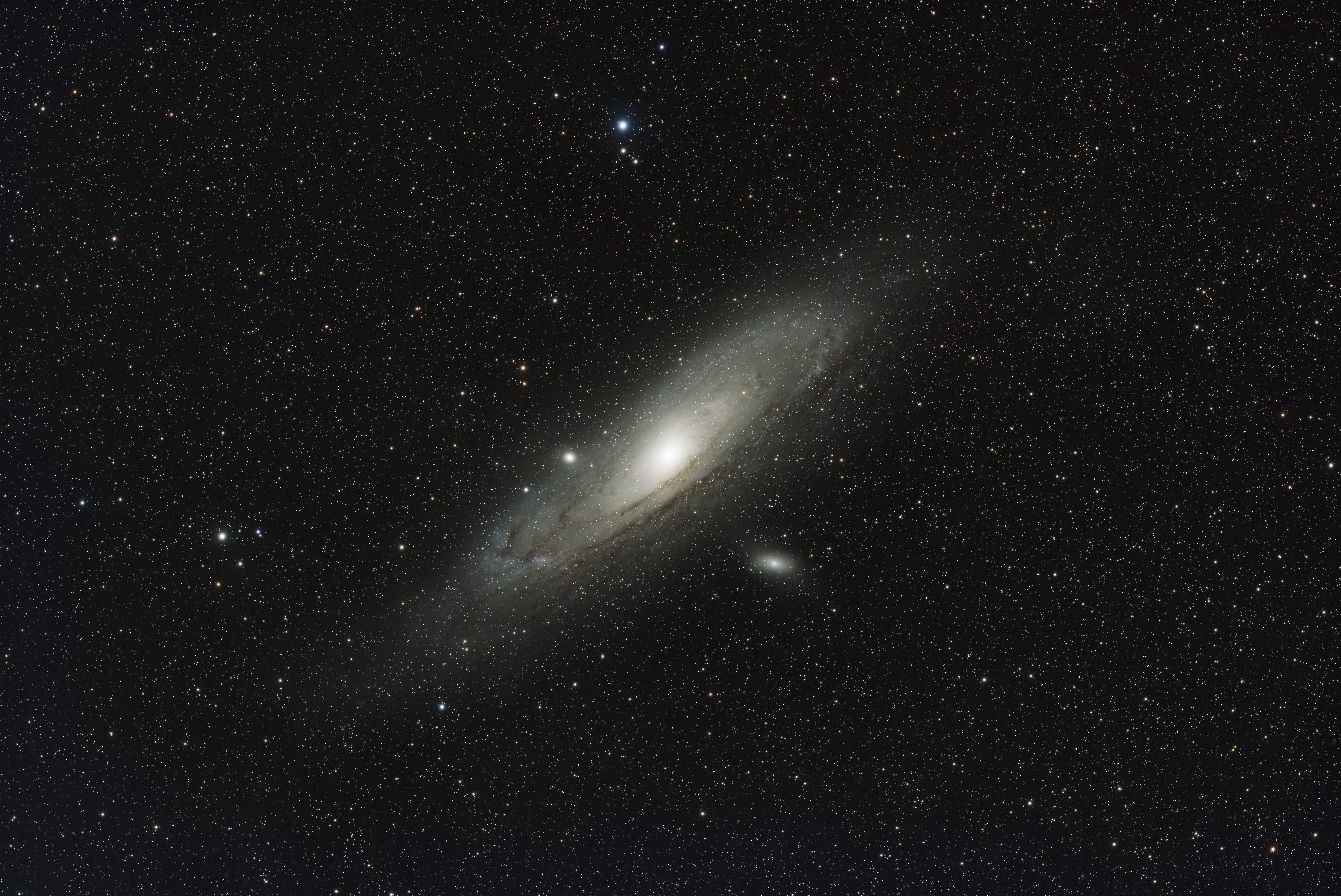
Round two on the Andromeda Galaxy. My first M31 back in January was a good start, but this time I wanted to fix the thing that always bugs me about Andromeda: the core. Expose long enough to pull out the faint outer disk and the bright core blows out to a white blob. Expose short enough to keep the core and the outer arms vanish into the noise.
So this one is an HDR: three separate exposure lengths, stacked separately and blended, with almost 12 hours of integration behind it.
is the closest large galaxy to the Milky Way, a giant spiral well over 150,000 light-years across and home to something like a trillion stars. From a dark site it's visible with the naked eye, and it's one of the most distant things you can see without a telescope.
Folders
File types

It isn't alone in the frame:
Andromeda is also heading our way at around 110 km/s. For decades the textbook answer was a guaranteed collision with the Milky Way in about 4–5 billion years. Newer studies put it closer to a coin flip over the next 10 billion years.
M31 is about 2.5 million light-years away, so the light in this image left around 2.5 million years ago, right at the start of the Pleistocene and the ice-age cycles. On Earth at that moment:
Compared with my M101 and M106 shots, which are 20+ million years old, this light is practically fresh. It still left before anyone had made a fire.
All shot from my Bortle 6 backyard over four nights in early October 2026 with the William Optics RedCat 51 (250 mm, f/4.9), ZWO ASI2600MC Air at gain 100 and −10 °C, on the ZWO AM5. That works out to about 3.1″ per pixel and a 5.4° × 3.6° field, wide enough for the whole galaxy plus both companions.
| Exposure | Frames | Integration | Nights | What it's for |
|---|---|---|---|---|
| 60s | 600 | 10h 00m | Oct 3, 6, 8 | Faint outer disk, dust lanes, background |
| 20s | 180 | 1h 00m | Oct 9 | Bridges the mid-tones |
| 5s | 686 | 57m | Oct 8 | Keeps the core from clipping |
| Total | 1,466 | ~11h 57m |
Calibration: 75 biases, 50 flats with 50 matching flat-darks, and 50 darks for each exposure length.
The raw frames for all three exposure sets are in the linked M31_V2 integration set.
Gear
3 items
ZWO ASI2600MC Air
ZWO AM5N
William Optics RedCat 51
Notes
M31 (Andromeda) — ASI2600MC Air on AM5N, 60s @ gain100, Bin1, -10C. Lights captured 2026-10-03/04 (240 × 60s = 4h00m); more guided lights from 2026-10-06 to follow. Calibration from 2026-10-04: darks 50 × 60s, bias 75 × 1ms, flats 50 × 16.7ms, flat-darks 50 × 16.7ms (in flat-darks/, pending darkflat stack support — lumigraph#828). Filename angle 270deg/90deg = pre/post meridian flip, same flats apply. Local staging: ~/Astrophotography/M31_V2.